Showing posts with label 2010. Show all posts

Ducati Desmosedici RR, 2010

Ducati Desmosedici RR, 2010


DUCATI DESMOSEDICI RR: THE ULTIMATE DUCATI EXPERIENCE

The dream of a true GP replica has finally come true and the Desmosedici RR will be the first-ever road-going motorcycle to offer such a stunning wealth of performance and technology that comes directly from Ducati's experience in MotoGP. The RR derives from the Ducati Corse Grand Prix racing Desmosedici GP6, the same bike with which Loris Capirossi and Sete Gibernau are competing with in the 2006 MotoGP World Championship.
The body design and the aerodynamics faithfully reflect the Desmosedici GP6. The colour scheme, the fittings, the materials used in its construction as well as the technical features of the powerful four-cylinder desmodromic engine built by the Borgo Panigale factory engineers, leave no doubts whatsoever: the Desmosedici RR is the ultimate expression of the most extreme MotoGP racing machine today.
This is the new frontier of Ducati technological evolution, a dream come true, demonstrating once again the courage and the passion of Ducati, as well as the ability to transfer the experience of the racing world to a machine that is destined for road use.

The Engine
The Ducati Desmosedici RR features advanced technology and aerodynamics that are derived from the GP6 currently being raced in the 2006 MotoGP World Championship.
The engine of the Desmosedici RR accurately reflects that of the MotoGP bike: Ducati's traditional desmodromic distribution, guaranteeing precise valve control up to the highest revs, is perfectly matched to the 989 cc four-cylinder 'L' layout, with four titanium valves per cylinder, in asymmetrical Twin Pulse configuration, producing a masterwork of precision engineering.
The double overhead cams are gear driven, a sophisticated and reliable solution that enables precise valve timing in all conditions. This authentic copy of the Grand Prix engine is completed by a six-speed transmission, which retains its 'racing' characteristic by being cassette type, and a hydraulically actuated dry multi-plate slipper clutch.
The aim of producing a light but robust engine has led not only to an unrivalled quality component design but also the use of exclusive racing-derived materials: sand-cast, aluminium crankcase and cylinder heads, titanium connecting rods and valves, sand-cast magnesium engine covers.

Four 50 mm Magneti Marelli throttle bodies are present, with 12-hole 'microjet' injectors. For sophisticated management of the powerful four-cylinder engine a Magneti Marelli 5SM ECU and high-speed CAN line electronics have been used.
An all-time 'first' comes with the use of a '4 into 2 into 1' exhaust, with "vertical exit" silencer, hidden in the tail cover.
These are all benchmark performance features for a MotoGP replica bike, which is capable of delivering more than 200 hp of power with the 102 dB racing silencer and dedicated CPU race kit.
Amazingly the Desmosedici RR with its catalytic oxygen sensor exhaust, homologated for road use, fully complies with Euro3 emissions regulations.

The Chassis
The engine clearly represents the beating heart of this fantastic motorcycle, but the technological advancements also extend to the chassis: a signature tubular trellis hybrid frame, refined components, and a superb carbon fibre body. This is a motorcycle that is destined for an expert rider, someone who is always looking for extreme sporting performance, as well as being an exclusive, esoteric, reliable product that is more than capable of track racing.
The colour scheme of the Desmosedici RR was the work of Alan Jenkins, the designer and one of the men behind the Desmosedici MotoGP, who was also responsible for the aerodynamics package which is aimed at achieving maximum speed and excellent handling. The bike is totally inspired by the racing machine, the Ducati Desmosedici GP6, from which it inherits all the aggressiveness of its lines. It is fitted with a new lightweight multifunction dashboard, developed in collaboration with Ducati Corse, the same one that will be fitted to next year's racing machine, the Desmosedici GP7.
The bike's development could not have been made possible without the significant collaboration of Vittoriano Guareschi, the official Ducati Corse tester, whose riding abilities and hundreds of hours of track time have made a fundamental contribution to the evolution of the project.

For the first time the Ducati Desmosedici RR uses a new welded tubular steel trellis hybrid frame (ALS 450) with the frame geometry that is the same as that of the Desmosedici GP6.
This construction guarantees an excellent stiffness to weight ratio, allowing superior manoevrability and riding precision. Attached to the red frame is the rear seat support in high temperature resin type carbon fibre. This material, normally used only on racing bikes, has the characteristic of being extremely lightweight but exceptionally rigid.
The Desmosedici RR sports a new extra-long, cast, forged and pressed aluminium alloy swingarm. The geometry and the technology of this component derive directly from the MotoGP bike, and give the RR a high level of traction control, and excellent weight distribution as well as a superb stiffness to weight ratio.

In the suspension department the Ducati Desmosedici RR features the most advanced technical components.
The rear suspension geometry and layout is the same as that of the GP6, with the rear shock attached above the swingarm and to a rocker, which is hinged to the crankcase.
The front suspension features 43 mm upside-down Öhlins FG353 pressurized forks (PFF), with TiN coated sliders. The forks, which come directly from competition use, as well as being pressurized thus ensuring excellent track performance, are fully adjustable in preload, rebound and compression.

The DUCATI DESMOSEDICI RR Technical Specifications :

Engine
Type L-4 cylinder, liquid-cooled, DOHC, Desmodromic, 4 valves per cylinder, gear driven camshafts
Displacement 989 cc
Power More than 200 HP @ 13,500 rpm* Torque n/a
Fuel injection Four 50 mm Magneti Marelli throttle bodies, 12-hole "microjet"with injectors over throttle, manual idle control;
Exhaust '4 into 2 into 1'vertical exit exhaust/silencer
Emissions Euro 3

The Trasmission
Gearbox 6-speed; Cassette type
Clutch Dry multi-plate slipper clutch, hydraulically actuated

The Syspension
Body Full carbon fibre bodywork
Frame Tubular steel trellis hybrid, carbon fibre seat support, aluminium swingarm
Front Suspension Ohlins 'FG353' PFF forks USD 43 mm pressurized, with preload, rebound and compression adjustment, TiN coated sliders
Front Wheel Marchesini forged and machined magnesium alloy wheels, with 7 spoke design as GP6
Rear Suspension Ohlins rear shock, with rebound, low/high speed compression adjustment, and hydraulic preload adjustment
Rear Wheel Marchesini forged and machined magnesium alloy wheels, with 7 spoke design as GP6
Tyres Bridgestone
Front Brake Two Brembo radial "monoblock" callipers with four 34 mm pistons; two semi-floating 320 mm x 6 mm discs, with machined flange: the same as GP6 wet race set-up
Rear Brake 240 mm fixed disc, calliper with two 34 mm pistons
Fuel tank aluminium alloy
Dry Weight n/a
Instruments New lightweight Corse electronic multifunction dashboard with LCD 'bar' graph tachometer, trip/odometer, anti-theft immobilizer, lap time measurement, oil pressure, fuel reserve, EOBD, clock, air temperature, rev counter.

Honda Gold Wing GL18HPM Audio Comfort, 2010

Honda Gold Wing GL18HPM Audio Comfort, 2010


Experience the ultimate touring machine.

Hailed the world over as the undisputed champion of two-wheeled touring, the Honda Gold Wing® 1800 continues its reign as king of the road in 2010 as it brings an unmatched array of amenities for the long-haul rider. Luxury packages for GPS navigation, airbag, cold-weather comfort and more top off the superior power and handling available in every Gold Wing.

When it comes to touring, there’s really only one bike that should ever enter the conversation. That’s the Gold Wing, Honda powersports’ standard-bearer, the technological and luxury feature showcase rolled up into a machine Cycle World magazine has named one of its “Top 10 Bikes” an incredible 17 times! No surprise, since the Gold Wing is truly a touring bike that has it all: power, sporting performance, and long-range amenities to make any trip a first-class ticket to paradise.
Features
Four To Choose From.
We offer the Gold Wing in four distinct performance package options, with exclusive features like Premium Audio, XM Radio with Navigation, traffic and weather, a Tire Pressure Monitoring System, ABS, heated grips and seat, and even one with the industry’s first airbag.

XM Marks the Spot.

Stay on course and stay out of the weather, thanks to the available XM-equipped Gold Wing’s traffic and weather features available in addition to XM’s incredible line-up of music, news, sports, and entertainment programming.

Real-Time XM NavTraffic

Because the open road should be just that—open.Want to know the remedy for rush-hour headaches and congested roads? Real-Time XM NavTraffic, the nation's leading satellite-delivered traffic information service—and one of the coolest new features on the 2009 Gold Wing.

Charting a congestion-free course couldn't be easier with integrated traffic information.
XM NavTraffic combines constantly refreshing information on traffic conditions, collisions, incidents, roadwork and essentially anything that would slow your progress. The system then has the ability to reroute a rider around trouble spots as they appear on the Gold Wing's Nav screen.
It's hands-down the most accurate and reliable way to get the latest information on whether that open road you seek is actually open.

XM Radio
With this much on-road entertainment, why stay home? Over 170 channels of commercial-free content just a push-button away.

Classic rock to classical concertos. Hip-hop to hot jazz. Politics to public radio to premier sports. World music to world news and everything in between. That's XM Radio, which now includes the optional Best of SIRIUS, serving up more than 170 crystal-clear digital channels and the most entertainment no matter where you are. If it's on the air, it's on XM.

XM Radio so much content you may find yourself taking the long way home. On purpose. Check it out today—and find out what true listening pleasure is all about.
Features at a GlanceReal-time Traffic Real-time Weather XM Radio Previous Next
Why go through traffic when you can go around it? XM NavTraffic will help you find the road that truly is open.

Detailed and easy-to-read graphical weather overlays on your bike's Nav screen ensure you always know what you're riding into—before you get there.
Choose from over 170 channels featuring music, sports, news, talk, comedy, kids' shows and more. Your on-board listening pleasure has never been better—or more diverse.
Real-Time Weather

ENGINE

Engine Type 1832cc liquid-cooled horizontally opposed six-cylinder
Bore and Stroke 74mm x 71mm
Induction Programmed Fuel Injection (PGM-FI)
Ignition Computer-controlled digital with three-dimensional mapping
Compression Ratio 9.8:1
Valve Train SOHC; two valves per cylinder

DRIVE TRAIN
Transmission Five-speed including Overdrive, plus electric Reverse
Final Drive Shaft

CHASSIS / SUSPENSION / BRAKES

Front Suspension 45mm cartridge fork with anti-dive system, 5.5 inches travel
Rear Suspension Pro Arm® single-side swingarm with Pro-Link® single shock with computer-controlled spring
preload adjustment with two memory presets; 4.1 inches travel
Front Brake Dual full-floating 296mm discs with CBS three-piston calipers
Rear Brake Single ventilated 316mm disc with CBS three-piston caliper
Front Tire 130/70R-18
Rear Tire 180/60R-16

DIMENSIONS
Rake 29.15° (Caster Angle)
Trail 109mm (4.3 inches)
Wheelbase 66.5 inches
Seat Height 29.1 inches
Curb Weight 895 - 928 pounds, depending on option packages selected
Fuel Capacity 6.6 gallons

Can-Am Spyder RTS roadster, 2010

  Can-Am Spyder RTS roadster, 2010


Media Press Release
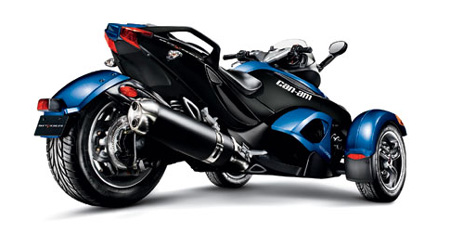
Washington, D.C., September 2, 2009 – BRP introduces the new Can-Am Spyder RT roadster in response to specific consumer demand for a touring platform. The 2010 Can-Am Spyder roadster line-up now includes the Spyder RS (roadster sport) and the Spyder RT (roadster touring) models.
The introduction of the touring model coincides with a substantial gain in market presence on the heels of strong consumer demand since the roadster’s launch more than two years ago. Driven by a passionate owner community, the innovative three-wheel concept has become a global phenomenon in more than 50 countries to-date with authorized BRP dealers.

The Can-Am Spyder RT roadster powered by a Rotax 991 engine with Electronic Throttle Control optimized for touring stays true to the brand’s promise to deliver a perfect balance of performance and peace of mind. The roadster features the same acclaimed BOSCH-engineered Vehicle Stability System (VSS) as found in the Spyder RS roadster, which includes Anti-lock Brakes, Traction Control and Stability Control systems. The VSS, coupled with the inherent stability of the roadster’s ‘Y-architecture’ and overall ease of use reinvents riding for enthusiasts of all skill levels.


BRP is also introducing an industry-first optional RT622 trailer package*, providing an additional 622 litres (22 cu. ft) of storage, designed specifically for the Spyder RT roadster and compatible with the vehicle’s stability system.

Bombardier Recreational Products (BRP), a privately-held company, is a world leader in the design, development, manufacturing, distribution and marketing of motorized recreational vehicles. Its portfolio of brands and products includes: Ski-Doo and Lynx snowmobiles, Sea-Doo watercraft and sport boats, Evinrude and Johnson outboard engines, direct injection technologies such as E-TEC, Can-Am all-terrain vehicles and roadsters, as well as Rotax engines and karts. With manufacturing facilities on three continents, BRP products are distributed in more than 80 countries.

Can-Am Spyder RS Roadster, 2010

The Can-Am Spyder RS Roadster, 2010


There's nothing ordinary about the way it looks. Or the way it rides, for that matter. You gas, it comes to life.

You steer, it reacts and adapts. With its Rotax 990 V-Twin engine and unique, three-wheeled stance, the Can-Am™ Spyder roadster offers a bold, new way to experience open-road freedom. And it all starts at the end of your driveway.
A trip on the 2010 Can-Am Spyder RS roadster isn't just an escape, it's a full-on performance get-a-way.
 
Features and Specifications:

  • Rotax 990 V-Twin Engine
  • 3-spoke aluminum wheels
  • Multi-Function gauge display

Storage
  • Mechanical reverse
  • 44-Liter Front Storage - Lockable front storage with 44 liters of space. Can fit two helmets.
  • 3-Spoke Aluminum Wheels - A unique, die-cast aluminum design that echoes the RS roadster's distinctive footprint.

Vehicle Stability System (VSS) - The Y-architecture enables the Spyder to host an innovative and unique stability system. Developed in conjunction with Bosch, the Vehicle Stability System (VSS) reduces the risk of losing control, integrated into Vehicle Stability System (VSS) and Stability Control system (SCS), Traction Control System (TCS) and Anti-lock Braking System (ABS) functions.

 TRANSMISSION

1. Manual 5-speed gearbox, true mechanical reverse (SM5).
2. Semi-automatic finger-trigger shifting (SE5).

Ducati 848 Nicky Hayden Edition, 2010

Ducati 848 Nicky Hayden Edition, 2010


The new Ducati 848 Nicky Hayden Edition enjoys all the performance advancements of the entire Superbike family, while adding its own innovations to redefine the middleweight sport bike class.

The words ‘agile’ and ‘refined’ aptly describe the 848. At 168kg (369lbs) the 848 is an amazing 20kg (44lbs) lighter than its predecessor, and a significant 5kg (11lbs) lighter than its larger capacity brother, the 1098.

The highly advanced 848 engine uses an improved method of engine case production in which cases are vacuum die-cast formed. While providing significant weight savings of more than 3kg (6.5lbs), this method also ensures consistent wall thickness and increased strength. Further refinements include a sophisticated wet clutch that offers 1kg (2.2lbs) less weight, a much higher service life, improved clutch feel and quiet operation.

With the first twist of the wrist, the powerful rush of the Testastretta Evoluzione engine confirms that the rules have changed. The 848’s 134hp is not only 30% more powerful than its predecessor, but it provides a power-to-weight ratio even better than the potent 999.

Several upgrades features in addition to the special Hayden livery and full specifications listed below:
  • LED dash illumination for better visibility – particularly at night
  • Inclusion of a 30mm mirror extension kit, enabling a choice of two stem lengths for better vision
  • Aluminium cam belt tensioner pulleys to reduce weight and moving mass; in turn enabling better acceleration.

Engine
The 848 Testastretta Evoluzione engine becomes the benchmark for the middleweight sportsbike category, benefitting from all the experience accumulated with the larger engine on the 1198. It successfully adopts the same design guidelines and the same compact cylinder and cylinder head layout, but introduces for the first time ever an innovative solution for the crankcase, which has been designed with a further weight reduction for this advanced engine in mind. The overall layout of this engine integrates a series of avant-guard solutions, confirming the close links with the experience of Ducati’s racing department.

The 849cc engine has bore and stroke values of 94mm and 61.2mm respectively, which produce a ratio that is only slightly inferior to the 1098 (1.54 compared with 1.61), while maintaining the highly ‘over-square’ layout typical of racing engines.

Power output is an impressive 134hp (98.5kW) at 10,000 rpm and maximum torque is 71 lb/ft (96Nm) at 8250 rpm. The power and torque values confirm the high performance level of this engine, especially when compared to its predecessor, the Testastretta-engined 749.

The cylinder head has been modified in line with the characteristic bore and stroke of the engine in order to optimize the fluid dynamics of the intake (straight and plunging) and exhaust ducts and combustion chamber. The compression ratio is 12:1.

The valve angle is the same as the 1198 engine and diameter is 39.5mm for the inlet valve and 32mm for the exhaust. The technology used sees the application of a bi-metallic alloy that combines increased lightness with resistance and reliability required for these particular components. The desmodromic control system has also been designed with the weight and the inertia of the new components in mind, allowing extremely efficient valve lift during intake and exhaust phases. The excellent results achieved are confirmed by the engine’s power figures, producing outstanding performance thanks also to the use of MotoGP-derived elliptical throttle bodies, which have been fitted to the 1198 engine. The 2010 model year sees the addition of new lightweight cam belt tensioner pulleys; improving performance while shaving weight.

The design of a dedicated elliptical throttle body for the 848 demonstrates the attention that Borgo Panigale engineers have devoted to the development of the Superbike range. The cross-section is reduced from the 60 sq. mm of the 1098 to 56 sq. mm so as to optimize fluid dynamics at every engine speed. Just like on the 1098, the new cylinder heads benefit from fewer components and include magnesium covers.

This Testastretta Evoluzione engine sees the introduction of a special technology for the construction of the engine crankcase: Vacural casting. This is a forced vacuum die casting method that allows jet characteristics to be improved thanks to the absence of porosity, gas inclusion and oxidation. This allows extremely high measurement precision and greater ductility for aluminium alloy. Designers have been able to harness the benefits of this innovative process by redefining the shape and the wall thickness of the new crankcase by means of FEA (Finite Element Analysis) checks, which allowed the required reliability standards to be achieved, while simultaneously obtaining a significant weight saving of 3.5kg.

The 848 engine is fitted with a silent modular wet clutch, characterized by an exceptional resistance to wear that will lead to superior duration. This solution makes a useful contribution to weight saving, estimated to be around 1.6kg, which is also due to the use of a different type of clutch cover.

The high power figures achieved by this engine also come from the use of the same type of oil cooler and coolant radiator as the 1198’s engine, with an increased surface area assisted by lightweight, high flow electric fan assemblies.

Finally, the 848’s exhaust system follows the same layout and uses the same innovative technology as the 1198. The system terminates with Ducati’s trademark twin under-seat silencers, delivering the unmistakable signature sound of the big bore 90° L-Twin.
This power unit, just like all the other Ducati engines, has been designed to comply with Euro 3 exhaust emission norms.

Chassis


Trellis frame
Developed in cooperation with Ducati Corse, the 848 Trellis frame has a simplified tube layout featuring main section tubes increased in diameter from 28mm to 34mm, while being reduced in thickness from 2mm to 1.5mm. The result is a 14% increase in rigidity and a weight saving of 1.5kg (3.3lbs).

Single-sided swingarm
The 848, as all the Superbike family, is equipped with a unique single-sided swingarm. The engineers were encouraged to re-think the construction technique of this element. The solution was to produce the main operational components using individual aluminium castings so as to ensure strength around the pivot points, wheel hub and suspension links, with fabricated aluminium sections used to complete the construction into a single, beautifully engineered component.

Rear suspension

Highlighting the way in which individual components are influenced by each other, the new lightweight Trellis frame and single-sided swingarm have enabled a more compact and further weight-saving rear suspension linkage system to be used featuring separate lower pick-up points for the push-rod and suspension unit. This ‘tandem’ design effectively reduces stress around the linkage pick-up area of the Trellis frame. Working together with this highly efficient linkage is a fully adjustable Showa single shock for the 848, the same as the 1198.

Front suspension

At the front the 848 is equipped with fully adjustable 43mm Showa forks with radial mounts. This type of front suspension is professionally track-tuned and offers superior road holding, delivers superior feedback, and helps every rider to be more confident and in control.

Control

Brembo Monobloc calipers
The 848 brake system is characterized by M4 calipers using four 32mm pistons and two radial mounted pads. Matched to the calipers are two 320mm discs and the combination of these elements achieves spectacular braking power.

Super lightweight wheels

The 848 also benefits from lightweight Marchesini Y-shaped spoke wheels. The weight saving of 250gr achieved on the front wheel substantially reduces the moment of inertia and enhances the 848’s change of direction and braking performance. The rear wheel is just as impressive with a complete redesign for its single-sided swingarm application that has resulted in a reduction of over 1kg compared with traditional Ducati single-sided swingarm fitments. Finally a 5.50” wheel fitted with a 180/55 tyre guarantees the maximum agility at the rear.

Electronics
Desmosedici-style digital instrumentation is taken from Ducati’s MotoGP GP9 project; and for 2010 now features LED backlighting for better visibility. This pure racing, minimalist solution has no switches or buttons to compromise its clean lines. Instead, information additional to the default read-outs is managed by handlebar-mounted switch gear, allowing the rider to scroll through and select from various menus. The default read-out presents rpm and speed, with the former displayed across the screen in a progressive bar graph. Optionally, the rpm and speed can be displayed in numeric values. The instrument display also doubles as a control panel for the activation of the data acquisition system as well as listing lap times recorded by using the high-beam flash button as a stopwatch.

With the purchase of the Ducati Data Analyser (DDA), which includes PC software, a USB-ready data retrieval card and instructions, owners are ready to review and analyse the performance of the bike and its rider, and make comparisons between various channels of information. The DDA is available from Ducati Performance.

Normally used on race bikes only, the system records numerous channels of data including throttle opening, vehicle speed, engine rpm, engine temperature, distance travelled, laps and lap times. The system also automatically calculates engine rpm and vehicle speed data so as to also display gear selection as an additional channel of information. At the end of a ride or track session, up to 2mb (approximately 3.5 hours) of data can be downloaded to your PC ready to compare, analyse and get an inside view of you and your 848’s performance.

Data can be analysed in graphic form with options to zoom into detail of specific sections. Dragging a trace along a timeline to reveal individual values of the above listed channels enables the user to analyse performance in the same way that data technicians are able to do in factory teams.

Instrumentation
Digital Dashboard that displays derivation MotoGP: speedometer, tachometer, lap time on the stopwatch, clock, air temperature, water temperature, battery voltage, odometer, trip odometer fuel, preventive maintenance indicator. Spies segnalatiche: neutral arrows. projector beam, limiter, oil pressure, fuel level. Other Features: immobilizer, integrated DDA. 

Coyote, 2010

Coyote, 2010 


 Specification:
Dry Weight - Front.261 lbs (118 kg)
Dry Weight - Rear.401 lbs (182 kg)
Dry Weight - Total.662 lbs (300 kg)
GVWR.1012 lbs (459 kg)
GAWR - Front. 345 lbs (156 kg)
GAWR - Rear. 667 lbs (303 kg

Fuel - Total.......................3.8 gal (14.4 L)
Fuel - Main.......................3.4 gal (13 L)
Fuel - Reserve...................0.4 gal (1.5 L)
Oil Capacity......................2.875 - 3 qts (2.7 - 2.8 L)
Frame Rake......................39 degrees
Tree Rake.........................3 degrees
Trail..................................4.74" (120.3 mm)
Front Suspension...............41 mm Telescopic
Fork Length.....................+2.0" (50.8 mm)
Seat Height.......................24.5" (622.3 mm)
Ground Clearance..............4.5" (114.3 mm)
Wheel Base.......................77.5" (1969 mm)
Total Length......................102.5" (2604 mm)
Front Brake.......................4-Piston Diff Bore
Rear Brake........................4-Piston
Front Tire...........................MH90-21 56V
Rear Tire...........................250/40-R18 81V
Front Tire Pressure.............40 psi (275.8 kPa)
Rear Tire Pressure...............42 psi (289.5 kPa)
Front Wheel........................21" x 2.15" (533.4 mm x 54.6 mm)
Rear Wheel........................18" x 8.50" (457.2 mm x 215.9 mm)
Engine................................OHV 45 degree V-Twin
Displacement.....................117 c.i. (1917 cc)
Bore x Stroke....................4.125" x 4.375" (104.8 mm x 111.1 mm)
Compression Ratio.............9.6:1
Fuel System.......................Carbureted
Transmission......................6-Speed
Primary Drive....................Comp/Balance Drive
Final Drive........................1.125" (28.6 mm) Belt
Ignition..............................Electronic Single Fire
Charging Output...............35 Amp
Battery.............................310 CCA/Sealed AGM

Buldog, 2010

 BULDOG, 2010


Specification:

Dry Weight - Front................................322 lbs (146 kg)
Dry Weight - Rear................................446 lbs (202 kg)
Dry Weight - Total.................................768 lbs (348 kg)
GVWR.................................................1208 lbs (548 kg)
GAWR - Front.....................................424 lbs (192 kg)
GAWR - Rear.......................................783 lbs (355 kg)
Saddlebag Capacity (lbs).......................15 lbs (6.8 kg) per bag
Saddlebag Volume (cu ft).......................1 cu ft per bag
Fuel - Total............................................4.5 gal (17.0 L)
Fuel - Main............................................4.1 gal (15.5 L)
Fuel - Reserve.......................................0.4 gal (1.5 L)
Oil Capacity..........................................3.5 qts (3.3 L)
Frame Rake..........................................34 degrees
Tree Rake.............................................3 degrees
Trail.......................................................4.8" (121.9 mm)
Front Suspension...................................41 mm Telescopic
Fork Length...........................................1.0" US (-25.4 mm)
Seat Height............................................24.25" (616.0 mm)
Ground Clearance..................................4.5" (114.3 mm)
Wheel Base............................................74.63" (1895.6 mm)
Total Length...........................................101.5" (2578 mm)
Front Brake............................................4-Piston Diff Bore
Rear Brake.............................................4-Piston
Front Tire................................................120/70-R21 62V
Rear Tire.................................................250/40-R18 81V
Front Tire Pressure..................................40 psi (275.8 kPa)
Rear Tire Pressure...................................42 psi (289.5 kPa)
Front Wheel............................................21" x 3.25" (533.4 mm x 82.5 mm)
Rear Wheel.............................................18" x 8.50" (457.2 mm x 215.9 mm)
Engine.....................................................OHV 45 degree V-Twin
Displacement...........................................111 c.i. (1807 cc)
Bore x Stroke..........................................4.125" x 4.125" (104.8 mm x 104.8 mm)
Compression Ratio...................................9.7:1
Fuel System.............................................CLEFI
Transmission............................................6-Speed
Primary Drive..........................................Chain - Spring Compensated
Final Drive.............................................. 1.125" (28.6 mm) Belt
Ignition.....................................................Electronic Single Fire
Charging Output.......................................35 Amp
Battery.....................................................310 CCA/Sealed AGM

Husaberg FE450 Enduro, 2010

Husaberg FE450 Enduro, 2010


The new generation  Husaberg FE450 Enduro, 2010
Key features

Upside-down fork
The fully adjustable 48 mm fork from WP Suspension has been further optimised to ensure even more responsive handling and provide high damping reserves. Combined with the increased 22 mm offset (previously 19 mm) of the CNC-machined triple clamps, this guarantees more reliable front wheel control.

Airbox
Positioned directly behind the fuel cap, it is covered by the front section of the seat. The airbox’s elevated position guarantees the intake of cool, clean air and maximum wading depth. The intake duct is in the direct downdraft from the filter to the cylinder.

Tank
The slim, 8.5 litre tank runs far below the seat to provide an optimal centre of gravity and is equipped with both a compact fuel pump and new reserve sensor. The transparent polyethylene also enables the fill level to be determined at a glance.

Exhaust System
The integration of the stainless steel exhaust manifold offers optimum protection from rock damage and keeps the rider from coming into direct contact with it.


Brakes
The latest Brembo front brake with optimised front brake pads for maximum braking performance at minimal effort. Effective single-piston brake caliper in the rear. Ultra-light wave discs for the ultimate braking performance and better self-cleaning of the brakes.

PDS Shock
Fully adjustable WP PDS shock with optimised setting for even more traction. Adjustable rebound damping and variable high and low speed compression damping guarantee the perfect configuration for all conditions.

Frame
Light double-cradle perimeter frame made of chrome-molybdenum. Guarantees the greatest torsional rigidity and secure tracking stability. Extremely slender lower tube loops. Minimal overall width. Unbeatable ground clearance.

Silencer
Especially light and made of highquality aluminium, the silencer assures compliance with all official noise limits.

Subframe
Cross-linked polyethylene (PE) ensures that the plastic construction has the highest stability values and a reduced weight at the same time. Many electric components have been perfectly imbedded in the rear fender.

Engine
Engine type Single cylinder, 4-stroke
Displacement 449.3 cc
Bore/Stroke 95 / 63.4 mm
Compression ratio 11.8 : 1
Starter/Battery Electric starter/12 V 7 Ah
Transmission 6 gears
Fuel system Keihin EFI
Control 4 V / OHC with rocker levers
Lubrication Pressure lubrication with 2 oil pumps
Engine Oil Motorex, SAE 10W-50
Primary ratio 33 : 76
Secondary drive 13 : 38 (13 : 52)
Cooling Liquid cooling
Clutch Wet multi-disc clutch, hydraulically operated
Engine Management System Keihin

Chassis
Frame Double cradle perimeter design 25CrMo4
Subframe Cross-linked Polyethylene (PE)
Handlebar Magura, Aluminium Ø 28 / 22 mm
Front suspension WP-USD Ø 48 mm
Rear suspension WP-PDS shock absorber
Suspension travel front/rear 300 / 335 mm
Front/rear brakes Disc brake Ø 260 mm/Disc brake Ø 220 mm
Front/rear rims 1.60 x 21" DID/2.15 x 18" DID
Front/rear tires 90/90-21"; 140/80-18"
Chain 5/8 x 1/4"
Silencer Aluminium
Steering Head Angle 63.5°
Wheel base 1,475 ± 10 mm
Ground clearance 390 mm
Seat height 985 mm
Tank capacitiy approx. 8.5 litres
Weight (Ready to Race) approx. 114 kg

Husaberg FE390 Enduro, 2010

Husaberg FE390 Enduro, 2010 

 
Key Features

Upside-down fork
The fully adjustable 48 mm fork from WP Suspension has been further optimised to ensure even more responsive handling and provide high damping reserves. Combined with the increased 22 mm offset (previously 19 mm) of the CNC-machined triple clamps, this guarantees more reliable front wheel control.

Airbox
Positioned directly behind the fuel cap, it is covered by the front section of the seat. The airbox’s elevated position guarantees the intake of cool, clean air and maximum wading depth. The intake duct is in the direct downdraft from the filter to the cylinder.

Tank
The slim, 8.5 litre tank runs far below the seat to provide an optimal centre of gravity and is equipped with both a compact fuel pump and new reserve sensor. The transparent polyethylene also enables the fill level to be determined at a glance.

Exhaust System
The integration of the stainless steel exhaust manifold offers optimum protection from rock damage and keeps the rider from coming into direct contact with it.


Brakes
The latest Brembo front brake with optimised front brake pads for maximum braking performance at minimal effort. Effective single-piston brake caliper in the rear. Ultra-light wave discs for the ultimate braking performance and better self-cleaning of the brakes.

PDS Shock
Fully adjustable WP PDS shock with optimised setting for even more traction. Adjustable rebound damping and variable high and low speed compression damping guarantee the perfect configuration for all conditions.

Frame
The light double-cradle perimeter frame made of chrome-molybdenum. Guarantees the greatest torsional rigidity and secure tracking stability. Extremely slender lower tube loops. Minimal overall width. Unbeatable ground clearance.

Silencer
Especially light and made of highquality aluminium, the silencer assures compliance with all official noise limits.

Subframe
Cross-linked polyethylene (PE) ensures that the plastic construction has the highest stability values and a reduced weight at the same time. Many electric components have been perfectly imbedded in the rear fender.

Can-Am Spyder RT Roadster, 2010

Can-Am Spyder RT Roadster 2010
Roadster Electronic Command Center (RECC)
Rotax 991 V-Twin Engine - At the core of the 2010 Can-Am Spyder RT roadster is the Rotax 991 V-Twin engine, featuring electronic throttle control specifically calibrated for touring.

Vehicle Stability System (VSS) - The Y-architecture enables the Spyder to host an innovative and unique stability system. Developed in conjunction with Bosch, the Vehicle Stability System (VSS) reduces the risk of losing control, integrated into Vehicle Stability System (VSS) and Stability Control system (SCS), Traction Control System (TCS) and Anti-lock Braking System (ABS) functions.

TRANSMISSION
SEMI-AUTOMATIC TRANSMISSION (SE5) With the Can-Am Spyder RT roadster’s optional semi-automatic 5-speed transmission with reverse, there’s no shifting with your foot. No clutching with your hand. Simply apply pressure with your left thumb to shift up, and use your forefinger to downshift. There’s more than one way to shift. It’s easy: thumb shifts up, index finger downshifts.

ROTAX Engine
Manufacturer BRP-Rotax
Type 991 V-Twin EFI
Displacement 998cc (60.90 cu. in.)
Bore 97 mm (3.82 in.)
Stroke 68 mm (2.68 in.)
Cylinder 2
Valves per cylinder DOHC 4
Max output 100 hp @ 7500 RPM (71 kW @ 7500 RPM)
Max torque 80 lb.-ft. @ 5500 RPM (104 Nm @ 5500 RPM)
Compression ratio 12.2:1
Ignition type Electronic ignition with dual output coil
Lubrication 5W40 Semi-Synthetic oil (summer grade)
Exhaust system 2-into-1 with catalytic converter
Cooling Liquid-cooled
Injection Multi-point EFI with 51 mm-diameter throttle bodies

Drive Train
Gear box 5-Speed manual (SM5) with remote electronic reverse interlock 5-Speed semi-automatic (SE5) with remote electronic reverse interlock (RT Audio & Convenience and RT-S models only)
Final drive 28/79 ratio final drive with carbon fibre-reinforced drive belt
Clutch Wet, multi-plate, manual operation through a hydraulic piston

Electric Equi pment
Magneto 650 Watts
Starter Electric
Battery Sealed maintenance-free, 12V, 21 Amp

Geometry
Front suspension Double A-Arm with anti-roll bar
Front suspension travel 5.94 in. (151 mm) gas shocks with 5-position cam adjustment
Rear suspension Swing-arm with monoshock
Rear suspension travel 5.71 in. (145 mm) with pneumatic adjustable preload (RT and RT Audio & Convenience models) 5.71 in. (145 mm) with electro-pneumatic remote adjustable preload (RT-S model only)
Chassis type SST Spyder (Surrounding Spar Technology)
Steering DPS (Dynamic Power Steering)

Tires & Wheels
Front tire KR21 165/65R14
Front nominal pressure 13-17 psi (90-117 kPa)
Rear tire KR21 225/50R15
Rear nominal pressure 26-30 psi (179-207 kPa)
Wheel size, front Aluminum 14x5 (355x127)
Metallic Silver (RT and RT Audio & Convenience models)
Smoked Chrome (RT-S model only)
Wheel size, rear Aluminum 15x7 (381x178)
Metallic Silver

Brakes
Type Foot-actuated, fully integrated hydraulic 3-wheel braking system
Front braking system 4 piston calipers with a diameter of 31.75 mm (1.25 in.) each (250 mm x 6 mm) discs
Rear braking system Single-piston sliding pins caliper with a diameter of 38.1 mm (1.500 in.) (250 mm x 6 mm) disc
EBD Electronic Brake Distribution
ABS Anti-lock Braking System
Parking brake Electro-mechanical park brake system with actuator on the rear caliper


Safety & Security
VSS Vehicle Stability System
ABS Anti-lock Braking System
TCS Traction Control System
SCS Stability Control System with roll-over mitigation
DPS Dynamic Power Steering
DESS Digitally Encoded Security System
Vehicle Dimensions & Weights
Dry weight 929 lb. (421 kg)
Front max load capacity 30 lb. (15.9 kg)
Total vehicle load allowed 525 lb. (240 kg)
Trailer towing capacity 400 lb. (181.4 kg)
Fuel capacity 6.6 US gal. (25 l)
Oil capacity 0.9 US gal. (3.5 l)
Coolant capacity 0.85 US gal. (3.2 l)
GVWR 1,188 lb. (540 kg)
Ground clearance 4.5 in. (115 mm)
Vehicle overall height 59.4 in. (1,510 mm)
Vehicle overall length 105 in. (2,667 mm)
Vehicle overall width 62.3 in. (1,582 mm)
Seat (top) height 30.7 in. (780 mm)
Wheel base 67.2 in. (1,708 mm)
Wheel track, front 54.5 in. (1,384 mm)
Type of gas Unleaded, 91 octane-minimum

Vehicle Storage Capacity
Total 40.95 US gal. (155 l)
Front 15.32 US gal. (58 l)
Glove box 0.53 US gal. (2 l)
Left cargo 6.87 US gal. (26 l)
Right cargo 6.87 US gal. (26 l)
Rear cargo 11.36 US gal. (43 l)

Instrumentation
Dual analog and color dot-matrix display w/speedometer, tachometer, engine temperature, fuel gauge, gear position, odometer, trip meter, hour meter, ambient temperature

Features
RT, RT Audio Convenience, RT-S

High windshield with electric height adjustment
Driver wind deflectors
Electronic cruise control
Electronic parking brake
Heated driver handlebar grips
AM/FM integrated audio system with handlebar controls, two front speakers and speed-compensating volume
iPod integration in rear top cargo with full-feature handlebar control displayed in dot-matrix visual interface
3.5 mm audio player input in rear top cargo with handlebar volume control
Two additional rear speakers and passenger audio controls
RT premium saddle with passenger backrest and driver lumbar rest
Passenger peg, adjustable
Passenger armrests
Heated passenger grips
Roadster Electronic Command Centre (RECC) with LED accent lighting
Fog lamps
5-LED accent lighting
Auxiliary 12V power socket in rear top cargo
Electronic front cargo release
Upgraded special edition trim
Front cargo light
Front cargo liner
Travel cover
Remote adjustable rear suspension
Trailer lock (barrel)
Two-year warranty
X – Standard Feature

The Can-Am Spyder RT roadster powered by a Rotax 991 engine with Electronic Throttle Control optimized for touring stays true to the brand’s promise to deliver a perfect balance of performance and peace of mind. The roadster features the same acclaimed BOSCH-engineered Vehicle Stability System (VSS) as found in the Spyder RS roadster, which includes Anti-lock Brakes, Traction Control and Stability Control systems. The VSS, coupled with the inherent stability of the roadster’s ‘Y-architecture’ and overall ease of use reinvents riding for enthusiasts of all skill levels.

The Spyder RT roadster will be available for trial at authorized BRP dealerships this fall. Consumers currently have the option to pre-order Premiere Edition Spyder RT-S roadsters for delivery in the fourth quarter of 2009.

Bombardier Recreational Products (BRP), a privately-held company, is a world leader in the design, development, manufacturing, distribution and marketing of motorized recreational vehicles. Its portfolio of brands and products includes: Ski-Doo and Lynx snowmobiles, Sea-Doo watercraft and sport boats, Evinrude and Johnson outboard engines, direct injection technologies such as E-TEC, Can-Am all-terrain vehicles and roadsters, as well as Rotax engines and karts. With manufacturing facilities on three continents, BRP products are distributed in more than 80 countries.

Sea-Doo, Ski-Doo, Lynx, Evinrude, Johnson, Can-Am, Rotax, E-TEC, Spyder and the BRP logo are trademarks of Bombardier Recreational Products Inc. or its affiliates. All other trademarks are the property of their respective owners.

Buell 1125CR, 2010

Buell 1125CR 2010

BUELL CONTINUES TO PUSH SPORTBIKE RIDING LIMITS

New Lightning CityX XB12SX brings more power to the streets
The Buell riding experience embodies radical designs and intuitive performance that rewards uncompromising riders, EAST TROY, Wis. (July 25, 2009).
From the race track to the back road, a Buell motorcycle will take any path necessary to put its rider out front because Buell believes a deep bond between rider and machine is the essence of motorcycling.

Buell maintains its defiant stance in 2010 with a versatile line-up of motorcycles designed to inspire riders to achieve ultimate performance. For the street, the 1125CR café racer with new upright handlebars, and the extended XB Lightning line-up for Europe – including the new Lightning CityX XB12SX motorcycle – are now packing more style and power than ever. In the sportbike category, in a nod to Buell’s increasing victories and success on track, riders will see even more of Buell’s convention-breaking liquid-cooled 1125R. For adventures that go way beyond the road, the Ulysses XB12 range sees various upgrades make it the most exhilarating ride yet.

In 2010 Buell continues to focus on the ride with the addition of features like front brake master cylinder piston seals and rotor mountings, LED taillights and rear turn signals, oxygen sensors and tyres, as well as new graphics and bodywork. Whether it’s the 1125cc Helicon liquid-cooled, four-stroke, fuel-injected 72-degree V-Twin engine or the 1203cc Thunderstorm air/oil/fan-cooled, four-stroke, fuel-injected 45-degree V-Twin engine, Buell blends original design with productive power and dynamic performance for a light and tight ride.

Out in the Street
For those looking for a bike with agile handling, as well as serious torque and acceleration for real urban power, MY10 sees the introduction of the new Lightning CityX XB12SX. Receiving its debut in Europe, the XB12SX marries the sheer power of the Thunderstorm™ 1203cc V-Twin engine with Buell’s popular Lightning CityX XB9SX chassis and suspension, inspired by the needs of today’s urban rider. Delivering a whopping 104 Nm/ 77 ft lbs of torque, the bike is available in Valencia Orange Translucent & Hero Blue Translucent, both with black wheels.

Meanwhile the Lightning CityX XB9SX, is readier than ever for a street fight, with the broad, smooth power of its Thunderstorm 984 V-Twin engine, wind deflectors, frame pucks, headlight grille, airbox cover X-guard and new Designer Black wheels. Features such as the upright rider position, wide Supermoto style handle bars and intuitive handling help the Lightning CityX XB9SX and XB12SX dodge through back streets and effortlessly pull away from the traffic – enabling the ultimate urban riding experience.

Buell XB Lightning streetfighters, powered by an air/oil/fan-cooled Thunderstorm V-Twin engine, have a ferocious look with new airbox cover graphics added to blacked-out frame, forks, engine and other components. Lightning XB models receive new oxygen sensor with updated calibration, fuel pump and sensor, front brake piston seal and LED taillight, and front and rear turn signals. The XB12Ss with supermoto-inspired long suspension has size, comfort and convenience, and the Lightning XB12Scg road-hugging suspension for a low centre of gravity.


Taking it to the Track
Whether on the street or the track, Buell sportbikes are engineered for high levels of performance and handling – providing a ride no less exhilarating than a bike built specifically for racing. This is perfectly illustrated by the Buell 1125R. European sport performance riders will see more of this convention-breaking, large capacity sport motorcycle in 2010. With its 72 degree liquid-cooled V-Twin 1125cc BRP-Rotax engine – exclusively designed to Buell specifications; all-new Buell IRC (Intuitive Response Chassis) - the stiffest chassis ever offered by Buell; Quiet Zone aerodynamics; and fully-adjustable Showa piggyback suspension.

On and off road
The sport-touring Buell Ulysses XB12XT and the versatile, all-road Ulysses XB12X are equally exhilarating rides in the Buell Adventure Sportbike category. Both Ulysses models feature a new right-side air scoop, fan shroud, header shield, and ECM calibration that work together to reduce heat and improve rider comfort.

Light and agile on any kind of road, the Ulysses XB12X is equipped with a broad, usable Thunderstorm 1203cc V-Twin engine, rugged protective features like frame pucks, headlight grille and wind deflectors. The XB12X has a new blacked out Phantom Metallic frame, swingarm, and footrest supports, and triple clamps, as well as new Sunfire Yellow bodywork and smoked windscreen. The Ulysses XB12XT is ready to carve the continents on new Pirelli Angel ST tyres with side and top cases, heated grips and a tall windscreen. Both Ulysses models feature the patented Triple Tail™ system that adjusts between three functional positions.

Model Highlights
New Tapered aluminum streetfighter handlebar
New Polished stainless steel headers
New Master cylinder piston seals for improved brake feel
New Engine cover sight glass for convenient oil-level checks
New Pre-wired battery tender harness
New Designer Black wheels with red pinstripe
New LED taillight
New Clear-lens rear turn signals
New Bodywork graphics and fly cut brake logos
New Arctic White/Midnight Black color combination
New Battery tender plug

= Buell ZTL2 four-pad, eight-piston front brake
= Two-piston rear brake caliper mounted directly to inner swingarm
= Brushed stainless steel exhaust outlets
= LED front turn signals integrated with mirrors
= Digital lap timer and gear indicator
= Minimalist flyscreen with integrated head lights
= Removable tail cowl over passenger seat
= Versatile riding position with relaxed footpegs and a short reach to the bars

= Buell Helicon 1125cc liquid-cooled fourstroke, 72-degree V-Twin engine with DDFI 3 Electronic Fuel Injection ECM
= Compact oblique stacked six-speed transmission configuration
= Ram-air pressurized air box
= Goodyear Hibrex final drive belt with Flexten Plus technology with a constant-tension pulley for smoother on/off throttle transitions
= Underslung muffler with Helmholtz chamber
= Twin side-mount radiators with outer covers designed to absorb impact
= HVA (Hydraulic Vacuum Assist) clutch with slipper action
= 6-spoke, cast aluminum wheels
= Pirelli Diablo Corsa III tires
= Steel braided brake lines
= Fully adjustable 47 mm Showa inverted fork
= Fully adjustable Showa rear shock absorber
= Fuel-in Frame Intuitive Response Chassis
= Rigid cast-aluminum swingarm
= Adjustable hand and foot controls

Electrical1
Battery Type and Specifications Sealed Lead Acid, maintenance-free, 12-volt, 12 amp-hour (per Battery Council International rating), 200 cca.
Charging System Specifications 37-amp, permanent magnet, three-phase alternator with solid-state regulator (520W peak power)
Starter System Specifications Starter motor 900W, starter drive (gears) and one way clutch.
Headlamp Type and Wattages (high, low and position lamp) Three-bulb headlamp with daylight running mode. 55 watt low beam (one (H7) 55 watt bulb), 110 watt high beam (one additional (H7) 55 watt bulb), 5 watt position lamp
Tail Light Wattages (stop and running) .55W for tail light, 5W for stop light
Turn Signal Lights Type (manual or self-canceling) and Wattage Manual cancelling, Front = non-serviceable LED's. 3W (per side), Rear = replaceable bulbs, 10W (per side).
License Plate Lamp Wattage 5W